For surface vessels, the restoring forces will depend on the craft’s metacentric height, the location of the CG and the CB as well as the shape and size of the water plane. Let denote the water plane area and:
The metacentric height where is the distance between the metacenter and CG
Definition metacenter
The theoretical point at which an imaginary vertical line trough the CB intersects another imaginary vertical line trough a new created when the body is displaced, or tilted, in the water.
Hydrostatics of floating vessels
For a floating vessel at rest, buoyancy and weight are in balance such that:
The hydrostatic force in heave is recognized as the difference of the gravitational and buoyancy forces:
where z is the displacement in heave and is the change in the displaced water.
Change in the displaced water can be written as:
is the waterplane area of the vessel as a function of the heave position.
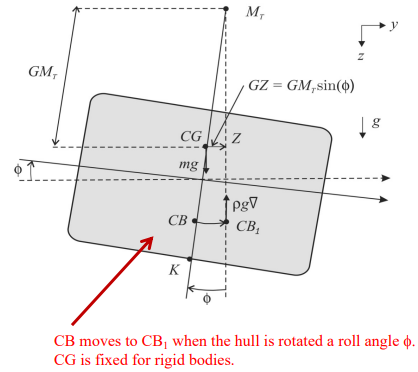
Perturbed buoyancy force vector due to variations in displaced volume
From this it follows that the total restoring force vector is:
where we have exploited that
Restoring moment
The moment arm in roll and pitch are and , respectively.
The restoring moment in body frame is equal to:
6-DOF generalized gravity and buoyance forces
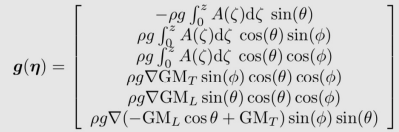
Linear (small angle) theory for boxed-shaped vessels
Assumes that , , are small such that:
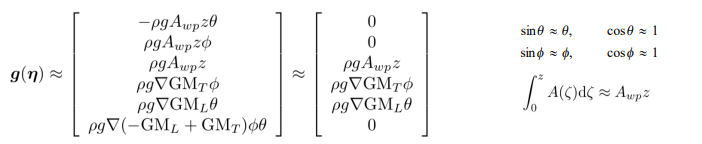
We have computed the G matrix in CF, that is the center of flotation:
We need to transform this expression to the CO.
If we transform to the CO, two additional coupling terms appears, this is shown below:
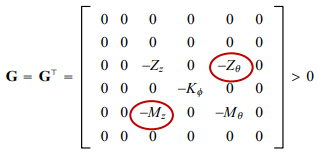
These coupling terms depend on the location of CF with respect to CO:
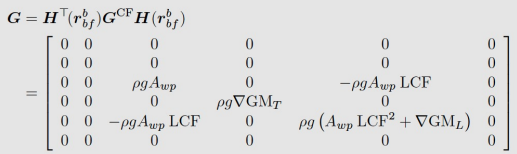
Computation of GM values
 Usually computed by software.
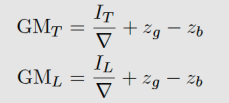 The GM values can be computed for given moment of areas, CG and CB using these formulas.
Computation of metacenter height for surface vessels
The metacenter height M can be computed by using basic hydrostatics
For small roll and pitch angles the transverse and longitudinal radius of curvature can be approximated by:
Moments of area about the waterplane:
For conventional ships an upper bound on these integrals can be found by considering a rectangular waterplane area where B and L are the beam and length of the hull upper bounded by:
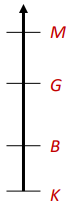
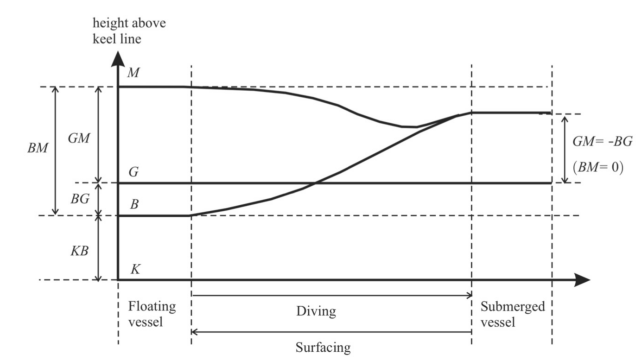 Metacenter M, center of gravity G and center of buoyancy B for a submerged and a floating vessel. The reference is the keel line K.
Metacenter stability
A floating vessel is said to be:
Transverse metacentrically stable if Transverse metacentrically stable if
The longitudinal stability requirement is easy to satisfy for ships since the pitching motion is quite limited. This corresponds to a large value. The lateral requirement, however, is an important design criterion used to prescribe sufficient stability in roll to avoid that the vessel does not roll around. The vessel must also have damage stability (stability margins) in case of accidents.
Typically, in roll while in pitch is much larger (more than 100.0 m).